Pages

Thursday, October 10, 2019

Hurricane Hilmar, The September MER, And Economic History

Based on the last three years, the EVE economy should pick up in September. I have my doubts. Just as people who flee a hurricane often don't return home (think the effect Hurricane Katrina had on the population of New Orleans in 2005), I expect many players won't return to EVE due to the massive disruptions to their game play. I also think problems in the RMT portion of the economy will continue and drag down the overall economy. As for the activities that require flying around in space, I fully expect the number of NPCs killed to drop in September, leading to another drop in the bounty ISK faucet. Perhaps growth and activity rates will return somewhat to normal, but for now, I don't see the situation improving until October.


- The Nosy Gamer, "Hurricane Hilmar", 11 September 2019


The monthly economic report for September came out Friday and I am still scrambling to catch up. I published a look at the NPC and player kill data for known space on Saturday, then spent most of the rest of the weekend either looking at data or finishing up my online class. Not a lot of time for playing video games, but a lot of time considering the EVE Online economy.
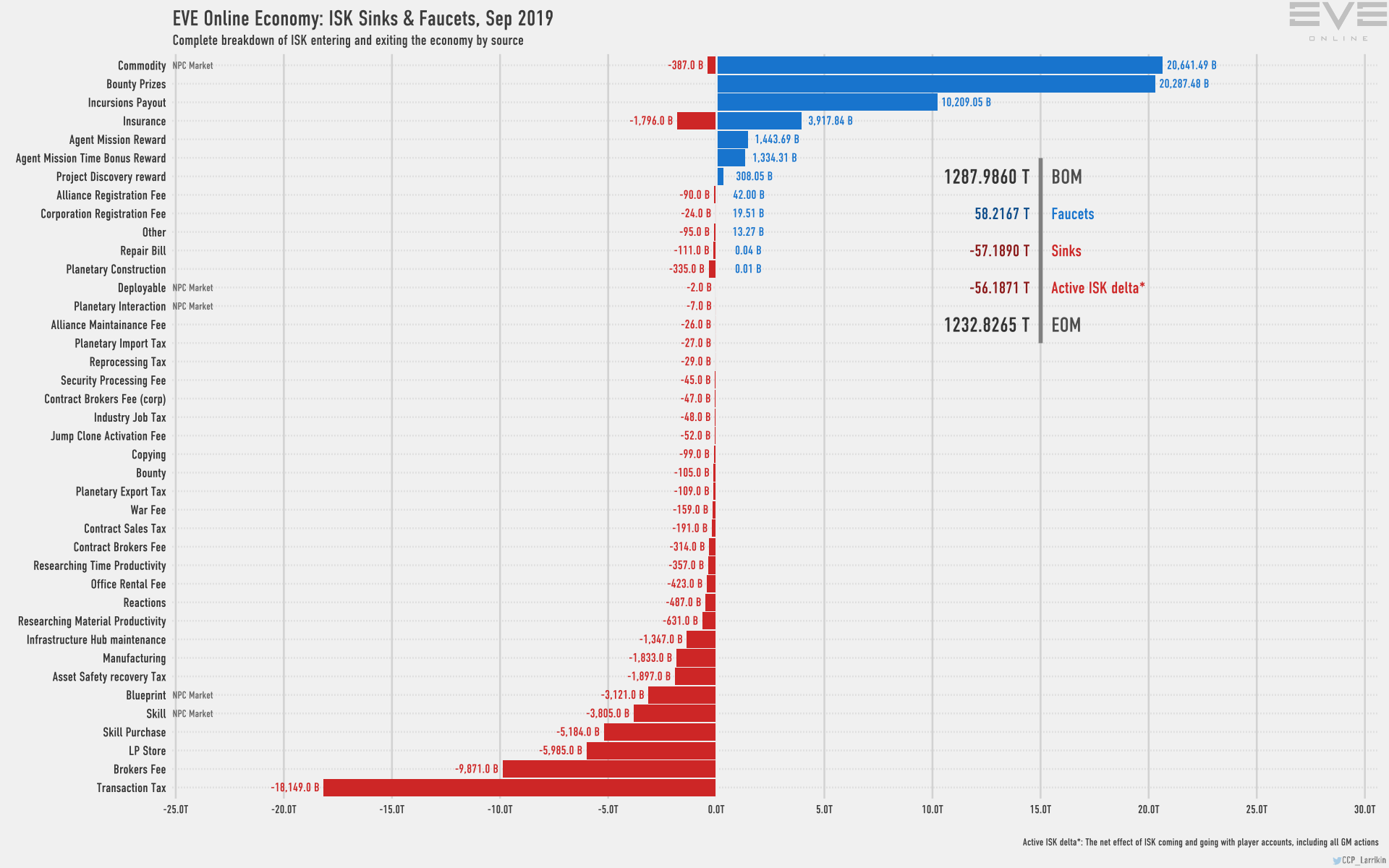


Two of CCP's goals are reducing the money supply and bringing the faucets and sinks into balance. In September, the money supply shrank another 4.3%, from 1,288 trillion ISK down to 1,232.8 trillion ISK. Going back to the end of June, the amount of ISK in the New Eden economy shrank 122.6 trillion, a 9% reduction during the so-called "Chaos Era".

Bounties, for the second month in a row, remained the second largest ISK faucet behind commodities. The gap, however, shrank to 354 billion ISK as commodity income fell nearly 3.2 trillion ISK, or 13.4% in September. Most of the decrease occurred in wormholes, as income in that area of space fell by over 2 trillion ISK. Overall, ISK faucets fell another 9% in September. Between June and September, the amount of ISK flowing into the game on a monthly basis dropped by 31.8%.

In September, currency sinks slowed down even faster than faucets. August saw an increase in taxes and fees that players apparently partially mitigated by training the Accounting and Broker Relations skills, which also received boosts two months ago. Still, the 19% reduction in taxes and broker fees collected was not all players training up their market skills. Overall, ISK faucets removed 18.3% less ISK in September than the month before. Going back to the beginning of summer, players payed 10% less in taxes and fees in


Looking at the summary data Friday was an "Oh, shit!" moment. In a month that historically sees relative stability (an average -0.2% decline from 2016-2018), the New Eden economy contracted by 12.6% in September 2019. All the racket readers may hear in the background are talking heads moving goalposts.


With Hurricane Hilmar (the institution of delayed, wormhole-style local in null security space) over on 16 September, the time came to look at the damage to the economy. From June to September, the economy had shrunk by 24.9%. The average during the summers of 2016-2018 was a decline of 10.3%. A decline so large I started wondering about the worst economic quarters in EVE history.


The third quarter of 2019, a period dominated by Hurricane Hilmar, was the sixth quarter going back to 2004 which experienced an economic contraction greater than 10%. Of the six quarters, four had experienced a quarter with over 50% growth immediately preceding the decline. The top three declines in quarterly economic activity were all related to Upwell structures.

The quarter with the largest contraction, Q1 2019, immediately followed the Onslaught expansion in November 2018 that introduced three new Upwell structures: the Ansiblex Jump Gate, Pharolux Cyno Beacon, and Tenebrex Cyno Jammer. The resulting massive infrastructure spending by the major null sec alliances in Q4 2018 resulted in a massive decline in economic activity in the first three months of 2019. The next largest decline, 36.7% in Q1 2018, followed the Lifeblood expansion released at the end of October 2017. The fourth quarter of 2017 witnessed the introduction of active moon mining, with refineries required for fracking operations to extract moon minerals. Once again, a massive infrastructure operation saw a decline in the economy after the frenetic activity to replace corp and alliance level income ended. The final Upwell-related decline occurred in Q4 2016. The Citadel expansion in April 2016 introduced Astrahus, Fortizar, and Keepstar Upwell structures to the game, and players began a massive effort to replace their existing POS.

The fifth largest quarterly contraction, the second quarter of 2016, was also a response to new content added to EVE in the previous quarter. In Februrary 2016, CCP not only introduced the skill trading system, but also seeded the Force Auxiliary skills for all races as well as the skill books for Light & Support Fighter skills.

The last quarter with a double-digit contraction in economic activity, Q4 2009, is somewhat of a mystery. Not only was the quarter the only one on the list that followed a quarter that also had an economic decline, but the quarter was part of EVE Online's first recession. The closest I can come to an explanation is the length of time between the two expansions in 2009. The first, Apocrypha, introduced wormholes to the game on 10 March 2009. The second, Dominion, replaced the old POS-based sovereignty system in null sec on 1 December. Perhaps, with the release of the news of the system change on 9 September, the null sec powers of the time delayed their fighting until the new sov system was in place.

Returning to the present day, what influenced the 15.5% contraction in the quarter just passed? The recent Invasion expansion launched on 28 May only resulted in a 1.1% increase in the economy in the second quarter. Indeed, if all RMT tokens (Daily Alpha Injectors, Large Skill Injectors, Multiple Pilot Training Certificates, Pilot's Body Resculpt Certificates, Skill Extractors, and Small Skill Injectors) are removed from consideration, the economy in the second quarter actually contracted by 1%. The simplest explanation is the content in the form of Hurricane Hilmar drove the lower economic activity.

What is going to happen in October? I doubt we will see growth matching the average of the three years, if only because The Crimson Harvest had such an outsized impact in 2018. A 2% expansion in October would prove a good outcome. My only concern about such a move is the weakness in the market for the RMT tokens. If The Crimson Harvest event comes back in the next week, the numbers would go much higher. In other words, I honestly don't know. CCP currently is doing its best to keep players in the dark about what to expect in the future. This month, reading the economic data does not help shed light.

Saturday, October 5, 2019

The EVE Online Blackout: September, The Curtain Lifts

September saw CCP lift the Blackout on null sec communications on the 16th of the month. Looking at the data is a bit of a problem as cynosural field changes arrived with the 9 September release. Still, the start of October is the first time we get to assess the damage done by Hurricane Hilmar and see how EVE players begin to recover from the developer-created disaster. With the early release of the monthly economic report for September yesterday, here's a rare Saturday post looking at the number of NPC and player-flown ships destroyed last month. Hopefully, the numbers below will serve as a useful supplement to all the economic analysis sure to pour out of the EVE media over the next few days.

NPC Deaths

First, a look at the top 10 regions in New Eden for NPC kills.

Data Source: Dotlan Maps


Even with normal local available for half the month, we can see more ratting activity in null sec. Deklein and Cobalt Edge joined Delve in the top 10 regions with the most NPC kills. Perhaps more notable was the 41.9% drop in NPCs killed in Delve in September. We will need to wait for the release of the September MER to see if The Imperium shifted its focus toward mining.


The daily average of NPCs destroyed by players possibly met the expectations of a lot of players. The number of NPCs in high security space decreased and the amount in null sec increased. What I think many players will find surprising is the size of the changes. In September, players killed nearly 936,000 fewer NPCs in high sec as compared to the month before. The corresponding increase in null security space was just short of 178,000 NPCs per day.


When comparing the statistics from 2019 vs the average number of NPCs killed from 2016-2018, the numbers were a lot worse. In the previous three years, the number of NPCs killed in all three security bands increased at least 14% from August to September, In 2019, the number of NPCs killed in high sec fell by 24.1% instead. While null sec did see an increase in ratting activity, the increase was only 40% that of the average of the three previous years.


With CCP restoring local in null sec back to normal on 16 September, many players expected an exodus of players from high sec back to null. Looking at the number of NPCs destroyed both before and after the event suggests that did not occur. While the daily average number of rats killed in null sec jumped an average of almost 1.68 million per day, the number of NPCs destroyed by players in high security space only fell a little more than 5,500 per day. Even including low sec, the drop of NPCs killed in empire space decreased by 21,000 per day, or 1/80th the increase in NPC kills in high sec. Clearly, a mass exodus of empire PvE players to null sec causing the increase in activity in the second half of September did not occur.


The individual monthly breakdowns are useful, but the question I get is, "What was the overall effect?" As one might expect, the regions that maintained normal local didn't receive much of an impact. While the event ran, empire space, consisting of the high and low security bans, saw increased activity. But once local was restored to null sec, activity returned to normal levels. In high sec, the average number of NPCs destroyed each day rose by 247 from June to September. Applying the average monthly changes in NPC kills from 2016-2018 to the actual number of NPCs killed in June would have resulted in a 2% drop. Null sec is the opposite. Over the last three years, null sec has averaged a very slight increase in NPC kills between June and September. In 2019, the decrease was 60.3%, or over 3.5 million fewer NPCs killed each day.

Player Ship Deaths

First, a look at the top 10 regions for player ship losses in September.

Data Source: Dotlan Maps

Once again, Detroid was the only null sec region on the list of top 10 regions for ship kills. An interesting development was that with only 1 more player ship loss in Detroid in September, the region jumped from 10th to 5th in the rankings.


If the numbers for NPCs dying were bad, the number of players dying throughout New Eden was a virtual drought. Overall, 5,857 fewer player ships died on average each day in September as compared to August. The decline was spread throughout all three security bands, with nearly 3,200 fewer player ships exploding in high sec, almost 1,100 in low sec, and over 1,500 in null sec. Even accounting for the extra day in August, September still witnessed over 175,000 fewer ships dying in New Eden than the month before.


The results in September also went against the trend of the last three years. Between 2016-2018, ship losses in both null sec and high sec would increase 4.0% to 4.5% with a very slight drop occurring in low sec. Instead, all three security bands experienced double-digit declines, with the drop in high sec reached almost 30%.


A look at ship losses after the end of the blackout might surprise some players. The number of player ship losses decreased outside of high sec in the second half of September. Low sec witnessed a decrease of 4.6% while null sec saw a 6.8% decline in player ships exploding. Apparently, the cyno changes had a bigger negative effect on PvP than changing how local worked in null sec.


The picture of PvP in New Eden during the summer of 2019 was pretty bleak. Not so much for both security bands in empire space. Yes, both high sec (-8.1%) and low security space (-17.9%) saw drops in the frequency player-operated ships disappeared in a blinding flash of light. The dip in the low sec numbers is even greater than the average over the previous three years. But null sec experienced a decline of 22.6% in the average number of players killed in September compared to the beginning of summer (or winter for those in the Southern Hemisphere). Perhaps more concerning, the number of ships exploding actually went down in the second half of September.

Final Analysis

I think the most important takeaway from the Dotlan data on NPC kills and player deaths is that the effects of the two-month implementation of delayed local in null sec will linger for months to come. Just because CCP flips a switch doesn't mean players who left the game due to a feature will return. As we saw with the war declaration system prior to the changes over the past year, players who disengage with EVE often don't come back.

I don't want to go too far beyond what the numbers in this post show. But one aspect I think is important is that null sec PvP took a giant hit with the blackout. I created one last graph to drive home the point.


This post is a quantitative examination of the activity in New Eden in September. Perhaps the quality of the fights players experience improved as the generation of kill mails slowed. From what I can tell, however, after an increase in July, the number of players dying in null sec decreased as the prey increasingly stayed docked up.

Looking into the future, I can safely predict the number of NPCs dying in New Eden will drastically increase, especially in null security space. An increase of 75% is entirely in the realm of possibility, with an outside chance of a doubling of NPCs killed. The number of player ships dying is a different story.

I want to predict that CCP is going to announce a new expansion that will get everyone excited and out in space blowing each other up. With the "Chaos Era" philosophy in play, I don't think that will occur. I'll try to remain positive and say that the number of ships exploding will increase in October but won't increase as much as the average increase from 2016-2018.

So overall, I predict a lot more explosions in October than in September. Now, if CCP will help me out and start up the hype train for an expansion launching on 3 December.

Thursday, October 3, 2019

Amarr and Minmatar Militias Unite

Opposing factional warfare sides working together is not unheard of. That said, giving each other control of your low sec factional warfare agent systems I think is a first in EVE Online history.


The following message was posted to both the official EVE Online forums and to the EVE Online sub-Reddit.  I post the message here because I don't want to lose such an extraordinary message. Plus, the effort might prove interesting to non-EVE players.

Today will be, we hope, a milestone to avoid the gravestone of our own corner of space.

The majority of Amarr and Minmatar Faction Warfare players agreed through their corps and alliances to lock down low-sec mission agents by swapping ownership of the systems where the latter are. The agreement comes into effect today and diplomacy is still ongoing to add more logos to the document above even at the temporary expanse of some of our RP traditions.

For the context, a FW Matari pilot can’t dock in an Amarr owned system and therefore can’t use the TLF mission agents there. And vice-versa : an FW Amarr capsuleer can’t dock and use 24th Imperial Crusade agents in a Minmatar controlled system. Only will remain the High Sec agents with their lower payout, ending in practice FW missions as an isk printing machine.

This decision doesn’t come lightly as it was our main source of income.

But those missions came at a price :

  • LP obtained through pvp and plexing became worthless market wise because devalued by the amount of LP gained and sold thanks to missions.
  • Faction Warfare was becoming more and more absurd with half of the militias just being pure pve/puller alts switching sides according to the market. The fate of the warzone was decided by the LP market, crashing and recovering : the so-called pendulum.
  • Faction Warfare missions were originally made easier to encourage people to run them in PVP fits and create interactions. Those missions have been since long min/maxed with insta-warp Jackdaws or bombers creating zero content.
  • People just kept leaving Faction Warfare only leaving an alt in both militias. Staying true to your side is a counter-productive strategy at the moment.

This experience will run provisionally for three months to collect data and draw attention to the FW and Low Sec situation.

Deleting missions on the long run is not a shared opinion. Most players want a rework of the missions to integrate them truly in the pvp lifestyle of Low Sec and FW. Waiting for the end of time and this rework, we decided to take the matter in our own hands.

What we are doing is the FW equivalent of asking Null Sec alliances to voluntarily unanchor their keepstars to fight super proliferation. But we will do it.
This decision is just the tip of a cross faction discussion which has been ongoing for months on a FW Discord. You can find this Discord and all the votes there : FW Discord. You are welcome to join it.

See you to pvp in a farmer free warzone we hope,
What metrics could the FW players look at to judge the effect of their efforts? I can think of three. The first is the number of ship killed in low sec. The second is the prices of various items found in the loyalty point stores of the 24th Imperial Crusade and Tribal Liberation Force, the two NPC corporations that supply FW players with items. The final metric is the ISK sink for loyalty point stores found in the monthly economic report.

Three major factors will complicate any such analysis. The first is New Eden's recovery from Hurricane Hilmar. Players will find themselves digging out from that event for months. The second is the changes in which ships can fit cynosural field generators. We really don't know what effect that will have on the amount of PvP in low sec. The third, of course, is that all of the farmers will just go to the Caldari-Gallente war zone and continue their ISK making ways there.

Whether the effort succeeds or fails, I do have to give mad props to those making the effort. Maybe CCP will finally push factional warfare fixes up their priority list. But I doubt it.


Wednesday, October 2, 2019

An Unusual Announcement

I don't think EVE Online did well in September. The final NPC and ship kill data is now available and I'm making graphs and writing a post about what I see. But before I could start typing, CCP made what I consider an unusual announcement.

SKILLING SPREE RETURNS!

We’re super happy to announce that due to popular demand, the Skilling Spree is back!

As of today’s daily downtime, pilots will be able to earn up to 50,000 additional skill points per day by taking part in the Skilling Spree and completing challenges.

Each day, pilots will receive one of three randomly selected challenges at daily downtime that offer either 10,000, 25,000 or 50,000 skill points as a reward for destroying NPC vessels.

If the challenge is completed successfully, the skill points will be rewarded, and the pilot will receive a new challenge at the next daily downtime.

If the challenge is not completed successfully, it will be replaced by another that's randomly selected during the next daily downtime at 11:00 UTC.

Pilots across New Eden are eligible for these challenges regardless of clone state, so there’s never been a better time to lock and load, and head on out into space to earn some extra skill points!
"What is so unusual about the announcement?" you may reasonably ask. This simple announcement of an in-game promotion is missing one standard item: an end date.

If this is another stupid application of "Chaos Era" thinking, making players guess when the feature will expire, I will scream. Another popular event, The Crimson Harvest, usually begins in October. I'm guessing some brilliant soul figures that publishing the end date for this new promotion would tip off when The Crimson Harvest will begin. Can't have that, can we?

Or perhaps someone at CCP wants to run this new "Skilling Spree" for over a month and doesn't want to face a player backlash. One thing I'm fairly sure of is that since CCP Falcon wrote the article, the omission probably wasn't just a mistake. Probably.

Whatever CCP's plans, we'll find out in a few weeks, either through an announcement at EVE Vegas or through the normal course of events. For this announcement, I think CCP is taking the concept of keeping players in the dark just a little too far.

Monday, September 30, 2019

World of Warcraft Subscription Revenue Triples

The 800 pound gorilla in the MMORPG space is still World of Warcraft. I expect that come the reporting season for the third quarter of 2019, the launch of the WoW Classic servers will come up time and again as the reason for declining revenues. And for good reason.

According to Superdata, subscription revenue for WoW rose 223% in August compared to July. That figure probably means a couple of million people returned to play WoW, including from other games. We've heard anecdotal evidence of people leaving EVE to play WoW Classic. I'm not sure all games are affected, however. I started playing Final Fantasy XIV, and even after the launch of WoW Classic, I still encounter a login queue every time I go to play. The financial reporting season coming up in November should prove quite interesting.

Thursday, September 26, 2019

In Search Of New Metrics

A big part of my RMT tracking disappeared last week. Player Auctions, the big site that sells game currency like gold, platinum, gil, and ISK, stopped displaying how much PLEX and skill injectors are involved in transactions. In other words, I can track the number of transactions, just not how many PLEX and injectors were sold.

Last week was not the first time a change affected the data I collect. Back in January 2018, the RMT site stopped publishing transactions without reviews. Due to moving my data entry interface to Google forms at the beginning of 2017, I could remove the non-reviewed transactions from my data in 2017, but not for 2015 and 2016. What that meant is that I can still compare prices from before 2017, but not volumes.

I shouldn't complain too much. PA recently put in a feature that tracks the reviews of all ISK purchases, so I am more confident of the accuracy of my data on ISK sales than before. Also, I can at a glance tell if the ISK sellers are having a bad day.

For my blogging, I normally just wrote about ISK sales information anyway. I can continue as normal in that regard. I think I will need to do something new concerning RMT, though. I'm just not sure what.

Tuesday, September 24, 2019

The Myth Of The Migrating Bots

In a multiple choice test in EVE, many people, when in doubt, will answer "bots" if given the chance. Even I, someone who has written about botting and illicit real money trading for 8 years, at times find myself in awe at some of the theories thrown around. The latest use of bots as an explanation is quite damning of EVE Online as a game.

The question: Why did activity in null sec drop so much during Hurricane Hilmar, also known as the blackout? The answer, at least in some quarters, was: all the bots moved to high sec.

I decided over the weekend to test the hypothesis that the answer was bots. If the answer was a mass migration of bots from null sec to high security space, we should see the following occur:

  1. A falloff of both NPC bounties and mining income in null sec.
  2. A corresponding increase in NPC bounties and mining income in high sec.

The data I chose to analyze comes from the RegionalStats.csv files from the May and August monthly economic reports. May was the last full month before the beginning of the so-called "Chaos Era", and August is the last month for which data is publicly available. I then chose a scatter plot to display the data for both NPC bounties and mining value on one plot for each month.


In the plots above, regions in the upper right-hand corner engage in large amounts of both mining and ratting, while the lower left corner represents less PvE. In May, New Eden had 5 null sec regions sitting on top of the PvE world: Delve, Branch, Deteroid, Esoteria, and Insmother. Another four had also separated themselves from the pack: Cobalt Edge, Deklein, Querious, and Fountain. Several other null sec regions gathered in between 1-2 trillion ISK in bounties

August was a completely different story. Except for Delve, no other region came close to exceeding either 2 trillion ISK in minerals mined or bounties collected. Even then, Delve's performance in August, while impressive under the conditions, still did not match its May output. And we should remember that the Imperium was deployed for part of May. The first part of the hypothesis appears correct. Null sec experienced a massive drop in both ratting and mining income.

I documented the damage caused by Hurricane Hilmar two weeks ago. The decline in activity in null sec is not a surprise. But what the above scatter plots showed was in August, no high sec region burst out with a fantastic performance. The next pair of plots strips out the null sec regions and just looks at those located in Empire space.


If a massive amount of bots flooded into high sec, one would expect to see at least a couple of regions increase either their mining value or bounty values by at least 200 billion ISK. I don't see any region even experiencing a 100 billion ISK increase. In other words, the condition that empire regions would see an increase in mining/bounty income in reaction to the massive decrease in null sec income fails.

I've read some of the arguments against this conclusion. The bots went to high sec and were banned. Yes, the 6,800 accounts banned for botting and illicit RMT activity in August was an impressive amount. I would also throw in CCP slowed down botting with the introduction of roaming bands of recon Triglavians, at least until bots were altered to take the threat into account.

I may not have all the answers, but I am sure of one thing. I have a basis for stating that bots didn't fill up high sec and overrun the place. While we know from anecdotal reports (and botter tears) that bots moved to high sec to set up shop, they didn't make enough of a impact to show up in the monthly economic report.

Friday, September 20, 2019

The Dream: Triglavians As A Playable Race

I have publicly stated that CCP needs a very good, if not amazing, winter expansion in order to recover from Hurricane Hilmar. We know that CCP is capable of such a feat. One only needs to look at the success of the Crucible expansion in the winter of 2011 after the disastrous Incarna expansion in June 2011 and the following Summer of Rage. The question is: can CCP come through in the clutch once again?

What could CCP pull out of the nearest volcano in order to not only entice old players to return, but new players to try out a 16-year-old game? Since walking in stations is a pipe dream at this point, the answer is fairly obvious. Make the Triglavians a playable race.

"Wait a minute," I can hear people say, "CCP is devoting 70% of its development resources towards developing content for new players. They don't have the resources to create a fifth playable faction." I'm not convinced. CCP has already developed an extended Triglavian ship line consisting of:
  • Damavik (Frigate)
  • Kikimora (Destroyer)
  • Vedmak (Cruiser, Combat)
  • Rodiva (Cruiser, Logistics, tech 1)
  • Zarmazd (Cruiser, Logistics, tech 2)
  • Drekavac (Battlecruiser)
  • Leshak (Battleship)

We also know that the Triglavians are developing at least one capital- or supercapital-sized ship class. As the Triglavians emerge from Abyssal space, they are bound to develop more ship types in order to compete with the empires and their capsuleer allies.

Triglavian society seems set up around the template of the existing playable races. Just as players can choose between one of three bloodlines when creating a character, the Triglavians are divided into three "clades" that seem very similar to bloodlines. Combined with the advanced ship line for a pirate faction, seems like CCP left the door open to eventually allowing players to play the Triglavians. Now is a good time to unleash the surprise.

Another factor in picking the Triglavians as a playable race is their origins in Abyssal space. CCP's art team has already created a lot of art assets that the developers could use to construct a new home. Just think, a home in Abyssal space that veteran players couldn't reach.

Assuming a home in Abyssal space also solves a problem: where would the starter areas for the Triglavians fit in New Eden? At this point in the game's life, the last thing needed is a new region. Adding a new home in Abyssal space would also answer the question, "Where do Triglavians come from?"

From a new player perspective, Abyssal space gives CCP some leeway in helping train new capsuleers. Want a space to show off a ship's capabilities? Create a pocket. Want to provide an area to practice? Create a pocket. No worries about making the activity area fit into the wider universe. Admittedly, others have had the idea, usually around the concept of computer simulations to train new players. The Triglavian pocket as training ground idea has the benefit of giving CCP the ability to have players lose actual ships in a fairly secure environment.

The big downside is character creation. Or is it? Yes, the Triglavians are always portrayed covered up from head to toe. I imagine players would want the ability to customize the physical appearance of their avatars. That requires art assets, and I don't think many people at CCP know how to manipulate the Carbon engine anymore. Perhaps CCP could use the opportunity to switch characters from the Carbon engine to Unreal Engine 4. Since CCP announced last year it was moving to UE4 for all future work, why not retrofit any character creation work on an FPS set in the EVE universe to EVE Online?

These are just some quick thoughts fleshing out the idea of CCP making available a fifth playable race. The idea of a fifth races has floated around as long as I have played. Ten years ago, players asked about the Jove. Perhaps the Triglavians are the answer to a lot of dreams.

Wednesday, September 18, 2019

Emerging Conduits: Stumbling Into Content

I suspect that those who don't follow the EVE news are happier people. Even happier are those in high security space. Except for the occasional Burn Jita, not much really bad happens. Ah, that life seems wonderful. No worrying about what Hilmar and Berger (CCP Burger, the creative director for EVE) were up to in a sauna in Finland. Blissfully unaware of the antics of The Mittani and the other null sec oligarchs. Someone whose enjoyment of the game isn't sucked out of them faster than a fully faction fit Bhaalgorn can drain the capacitor from an Atron by the toxicity of the EVE Online sub-Reddit.

I know, I know. I chose to become a blogger. Overall, the good has far outweighed the bad. But the recent hurricane coverage has taken a toll. So much data, so little time. I found a refuge from the storm in Final Fantasy XIV, but between blogging an the online class I'm taking, playing video games at all just doesn't happen during the week.

Last Wednesday night, with the post about Hurricane Hilmar published and my classwork complete, I decided to log into EVE Online. At a minimum, I needed to update the clients on both my computers, since I did not log in on patch day. When I logged in as Rosewalker, I found myself in a high sec station, sitting in a Vagabond. So I undocked with the intent of trying to find a group of recon Triglavians to shoot.

When I undocked, I looked down at my scanner and saw an Emerging Conduit at the top of the list. I didn't need to go hunting. I had a whole bunch in system with me.

I felt fairly confident in my Vagabond. I used it to run tier 3 abyssal sites. Plus, I heard the Triglavian ships did not scram, so if things got really scary, I could hit the assault damage control unit and warp out. For some reason, I decided to use Hornet IIs instead of Warrior IIs as my drone of choice. So with a questionable drone choice and Republic Fleet Fusion M loaded in my autocannons, off I went.

I landed in the site and wondered where all the Triglavians were. Then a dark portal formed and out came the Triglavians. As one might expect, the Triglavians came out in three waves. The first was easy enough to brush aside. The second was a bit tougher as Triglavian destroyer damage is nothing to sneeze at.

In between waves, I took the opportunity to salvage. The last time I was out, I had fit a Salvager II in the  utility slot instead of the nosferatu I fit when running Abyssal sites in order to ease any cap pressure. I was still salvaging when the third wave hit me.

The third wave can bring some serious pain, especially if one just sits there and lets the damage ramp up. Safety tip: don't let a Zoya's Vedmark and a support gang of 9 frigates and destroyers get in range. I wound up warping off. I then warped back, finished the remaining Triglavians, and began cleaning up the wrecks.

I discovered four important things about the sites in that first run. First, the NPCs drop red loot, which means looting the field is a must. The second was that half the value of the site was in the salvage. Third, the site contains an ore named Talassonite, which contains nocxium, zydrine, and megacyte. Finally, shortly after I completed the site, a new Emerging Conduit spawned and the one I disappared from scan. A site that a player could infinitely chain that has ore containing higher end minterals like nocxium, zydrine and megacyte? Okay. If the developers are incentivizing me into spending most of my time in high sec, I'm not going to fight want they clearly want me to do anymore.

With the next site, I decided to bring along a mobile tractor unit and log in Wandering Rose to salvage the wrecks in a Noctis. I also made a change in tactics. Instead of sitting stationary, I decided to dart into range, align to a station, and kite the Triglavians. On the third wave, I decided to pick off all the support ships and leave Zoya's Vedmark for last. The plan almost worked like a charm. The third wave, instead of making me warp off, didn't even get to half shields. I only had one issue. The Zoya's Vedmark warped off instead.

So I cleaned up the field, scooped  the MTU to my cargo hold, and dropped the loot off in the station. One more site for the night. I did everything the way I think will happen in the future. Warped into the site. Waited for the dark warp point to appear and then the Triglavians to appear. Dropped the MTU and darted into range of the NPCs. Started kiting and picking off the NPCs. On the third wave, warp off due to the extreme damage inflicted and to reset the Triglavian weapons. Warp back in and finish off the third wave. Clean up the field.

I did learn one final, important fact about the Emerging Conduits. After finishing up the last site, I warped back to the bookmark I made for the second site (I always bookmark my MTUs after dropping them). The asteroid belt was gone. Important safety tip: if you want to mine the talassonite in one of the new sites, always leave at least one ship in the site after all the NPCs are destroyed.

I had to experience mining talassonite, so on Sunday, I went back and logged in my little high sec mining fleet members who fly an Orca and two Skiffs. The fleet hanger and ore hold in the Orca, combined with the 15,000 m3 ore holds in each of the Skiffs, comes out to a nice round number of 250,000 m3. So I mined until all the space was filled. For those interested, I didn't come close to mining the belt out.

Due to talassonite taking up 16 m3 each, I only came away with 15,624 units of ore. I then took the ore to an NPC station for reprocessing. My return rate was 75.6%, which is pretty good for an NPC station in high sec. The minerals received were:

  • Megacyte - 1,534 units
  • Nocxium - 53,812 units
  • Tritanium - 1,486,917 units
  • Zydrine - 9,558 units

A ridiculously low amount for a Rorqual pilot, but I was happy to receive that type of higher end minerals in high sec.

After the mining session, I looked through my blueprints and found my 10-run Porpoise blueprint copy. I went nuts mining enough to build my Nestor and Marshal. With these new sites, a Porpoise will be a breeze. And with the mineral requirements for a Porpoise, I may post next Wednesday about my brand new ship.

Monday, September 16, 2019

The End Of The Blackout: Hurricane Hilmar Moves Back Out To Sea

I woke up Saturday to news that CCP would lift the imposition of delayed local today in null security space today. CCP chose not to delay its plans.
On July 5, we announced the local blackout for nullsec, which then came into effect on July 12.

This temporarily switched local chat over to delayed mode across nullsec space so that both chat and the intelligence service that it provides behaved the same as wormhole space.

Over the course of the blackout we’ve seen some substantial changes in player behavior and a massive impact on those we believe to be suspected of botting. The duration of the blackout wasn’t specified in order to allow us to gather information without a hard deadline for concluding it.

After 66 days, the blackout of local chat in nullsec will come to an end during downtime today, September 16 and local will return to immediate mode with full population counts and member lists.

The blackout has given us an incredible amount of insight in terms of player behavior, sentiment and ability to adapt to rapid short notice changes. This will help to better inform us on where to take the direction of New Eden in future.
Hurricane Hilmar didn't impact my game play directly. I don't play in null sec, and I don't buy RMT tokens like PLEX and skill injectors. A huge drop in players that affects the economic viability of keeping the servers running? I start to care.

I probably should wait for the September data to roll in before making any judgments. But I do feel we have enough data in now to make one conclusion. CCP let the situation go on too long. Given the way CCP introduced delayed local, I was sure the feature was a one month experiment ending with the release of the August patch on 13 August. When I saw the numbers, particularly for the PLEX market in The Forge, I thought for sure the developers would flip the switch and restore local. I was wrong.


As Ripard Teg's chart shows, the drop in average concurrent users took place after the August patch. Perhaps the decision makers looked at the data, didn't see a drop in Omega accounts or ACU, and decided they would continue the feature. Then the floor dropped out from under them.

Of course, I'm assuming what CCP's data showed them, as they have a lot more data than I do. I can only work with what is publicly available. The next real look we get at activity, outside looking at the PLEX market in The Forge, is 1 October when the final activity numbers for September appear on Dotlan.

Activity through 15 September. Source: Dotlan Maps
While the September MER will not have a lot of data for the mid-month change in local, the Dotlan data will provide some sort of rough approximation for the effect on player activity.

As for now, the big question is whether EVE Online will fully recover from the missteps, or if the game is permanently crippled. I honestly don't know. Which is why we look to the data we have to try to make an informed judgement.