Pages

Showing posts with label illicit_RMT. Show all posts

Friday, February 4, 2022

Blizzard Bans Boosting Communities In World Of Warcraft

So what is RMT?  At the most basic level, real money trading is the exchange of virtual goods, including in-game currency, and services for real world currency.

-- The Nosy Gamer, 2013

When I first heard of boosting services and communities in World of Warcraft, I first thought of real money trading. After all, how much different is running a character through a dungeon to get loot from the leveling services offered to get a character from level 1 to the maximum level of a game? Wait, you thought the evil game companies thought up character boosts were thought up by a bunch of greedy suits? Ha! The practice has been a staple of grey/black market sites for years.

An article in PC Gaming described the practice.

These boosting communities have a surprisingly elaborate process. They hire players to advertise their services on various servers. A buyer contacts them and pays them gold that is then paid to a "bank", or representatives of the boosting community. From there, boosters, who are paid with in-game gold from that bank, take on the job of getting players what they're after. All of this happens across multiple servers and is reported back to a centralized Discord server. This way, players who, for whatever reason, can't perform a tough raid or get a fancy mount, can either buy WoW Tokens for gold or pay the gold they already have for a group to help them. The advertisers, boosters, and other admins get to take that gold and continue their subscription or turn it into Blizzard bucks, if they want.

The only question was how much and how long Blizzard would tolerate the practice. The PC Gamer article makes the practice sound like everyone follows the rules. Hardly. Given the long history of WoW players violating Blizzard's rules, why would anyone think ToS violating activity was not occurring. Instead of buying WoW tokens for the gold to give the raiders offering the services, they could instead choose to either buy gold off the secondary markets or pay the groups directly using PayPal. Also, with that much gold floating around, some of the gold would inevitably find its way onto the secondary markets for sale.

On Monday, a blue post appeared on the WoW forums declaring changes to what Blizzard would allow in the future.

As the conditions change by which various entities operate in World of Warcraft, we are compelled to update our policies to further our goal of making the gameplay experience as fair and welcoming as possible. Since we last updated our policies, we have found that an increasing disturbance of the gameplay experience has been caused by organizations excessively advertising various non-traditional services in-game.

As of today, we will now prohibit organizations who offer boosting, matchmaking, escrow, or other non-traditional services, including those offered for gold. World of Warcraft accounts found to be in violation of this policy are subject to account actions. These actions can include warnings, account suspensions and, if necessary, permanent closure of the disruptive World of Warcraft account(s). Organizations operating across multiple realms and excessively advertising non-traditional in-game sales are contrary to the terms and conditions of the Blizzard End-User License Agreement (EULA).

This policy update does not restrict individuals or guilds from using the provided in-game tools (“trade channel” chat) to buy or sell in-game items or activities for in-game currency. However, “boosting communities”, especially those who operate across multiple realms, are no longer permitted.

We urge all such organizations to cease doing business in World of Warcraft immediately, in order to maintain uninterrupted access to the game.

I haven't played WoW since Vanilla, but I have written about real money trading activity for over 10 years. Unless the developers on WoW change the game mechanics that produced the demand for boosting services, a change in the rules won't stop the practice. At best, the boosting services will go underground, although on a smaller scale. For the short term though, perhaps the ban on boosting communities is the best Blizzard can do. Hopefully Blizzard will come up with a long term solution in the next expansion.

Monday, January 31, 2022

The End Of RMT Sales Monitoring

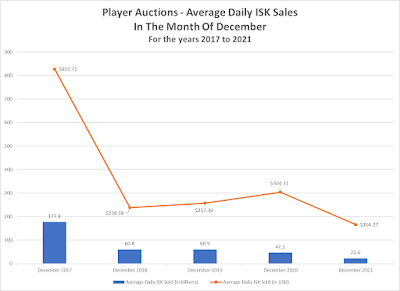
The day finally came. With the end of 2021 I stopped monitoring illicit ISK sales on the grey market site Player Auctions. After compiling a data base based on user reviews from January 2017 to December 2021, I think I have enough data to draw some conclusions and make pretty graphs. The one below is an example.

Do I think grey market sales have really declined 50% over the past year. No. Player Auctions has a much bigger competitor that has evolved over the past 5 years. Today, the site (which I won't name) boasts between 2 and 3 times the number of sellers as PA. Sellers on Player Auctions also have lost access to popular payment processors, such as PayPal and Alipay, for receiving funds for their sales.

What made Player Auctions unique was the ability to browse user reviews without a PA account. Following the irrelevance of independent ISK selling web sites in 2013-2014, I needed a source for price data. Player Auctions filled that role for years. But especially during 2021, the site was a shadow of its former glory, with the last major seller leaving at the end of October.

Five years is a long enough time to establish a good data set. For the last month, I have enjoyed not looking at sales data. Quite frankly, the story hasn't changed much. I took a quick look and the amount of ISK sold in January has risen from 24.7 billion ISK per day, which is up 9.3% from December's daily average of 22.6 billion ISK. When a change of 2 billion ISK makes that big of a difference, I need to find another source of data.

So goodbye daily monitoring. The next task is to take the gathered information and see if it proves or disproves my theories about RMT sales and the effect of PLEX on the grey/black market. In the meantime, I'm taking all the time I used to monitor the markets and am playing EVE instead.

Thursday, December 23, 2021

CCP's War On Illicit RMT: The Winter Status Update And The Hazard Discount

Last week CCP published its "Winter Status Update" which resulted in a lot of discussion. I was asked by a few people about a claim made in the conclusion of the dev blog.

The foundations of the EVE ecosystem are strong. PLEX prices have stabilized, stockpiles are healthy, great strides have been made in the war against botting (as evidenced by the skyrocketing RMT ISK price), and there are more ways to earn a living. The foundation allows us to build with more confidence and add more sand to the sandbox. What players can expect from now on is an increase in ship production, capitals out in space, new exciting strategic goals for small, medium, and large fleets – and more.

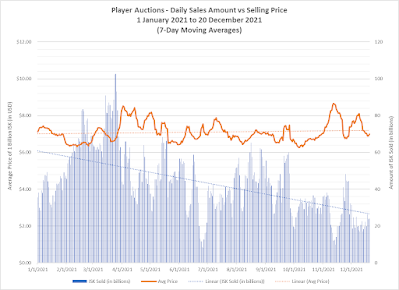
Was the price of ISK on the secondary markets (aka black or grey markets) really skyrocketing? Not at the time of the publication of the dev blog. I blame the delay in the publication of the dev blog, as the price on the black market did rise in late October and early November. Based on the buyer reviews on the RMT site Player Auctions, the 7-day moving average price of 1 billion ISK sold rose from $6.44/billion on 12 October to $8.66/billion on 12 November. I think a 34.5% increase in price over the course of a month could qualify as a skyrocketing price. However, by the time CCP released the dev blog on 14 December, the price had declined back down to $7.18/billion ISK. 


One of the problems with just looking at the sale price of illicitly sold ISK is the wide variation of prices. Over the course of 2021, the average price of ISK sold on Player Auctions varied by $2.39/billion with no discernable trend throughout the year.

A better metric to determine whether cost is affecting the sale of illicit ISK is the hazard discount. The hazard discount is the amount of a price reduction ISK sellers must offer buyers relative to the price of ISK purchased through CCP-approved means (aka the primary market) in order to entice those buyers into risking CCP banning all of their accounts.

During the period of time I believe the dev blog referred to as having skyrocketing secondary market, the price for ISK in The Forge also declined. The 7-day moving average of the value of ISK sold in Jita 4-4 and the TTT Keepstar also declined by 5%, from $13.06/billion ISK on 12 October, to $12.40/billion ISK on 12 November. But by the publication date of the dev blog, the value of ISK sold in The Forge rose back up to $13.12/billion ISK.

Overall, the hazard discount dropped 43.4% from 12 October to 12 November. People who were willing to risk CCP suspending or banning their accounts to save $33 by purchasing 5 billion ISK on the secondary market weren't so eager to do so when the savings dropped to under $19.

The hazard discount can also take into account the percentage of savings by buying ISK off the secondary markets. In our period of interest, the percentage the ISK price was under the value of ISK sold in markets in The Forge dropped from 50.6% on 12 October down to 30.2% on 12 November. The result was a big drop in ISK sales on PA. Sales had recovered in early December but were slumping again on 14 December with the hazard discount percentage at 45.3%

Now, I didn't address the "we're doing good against botting because the price of RMT ISK went up" argument. Does that mean CCP is doing bad because the price of ISK on the grey and black markets went back down? A pretty silly argument, in my opinion. More important is whether sales are going down. If the review data I collect from the Player Auctions website is any indication, the answer is yes.

Thursday, July 1, 2021

Top 10 Most Popular Posts For The First Half Of 2021

This year I've written more posts than I had three of the last four years. Not bad for six months. I don't come close to the 5,000 monthly readers that all the EVE Online Partner sites have, but that's okay. Writing the blog is something I do for fun. I don't want to turn a 12 year-old hobby into a job. MMORPGs tend to turn gameplay into a second job. Doing the same for writing isn't too appealing.

Still, I can't say I'm not interested in the traffic I receive. I thought I'd indulge myself and look back at my 10 most popular posts so far. Surprisingly, three of the top 10 most popular articles were written in 2021.

1. What Is RMT? - My most popular post ever, this November 2013 post was inspired by the big SomerBLINK scandal kicked off by DNS Black. In the aftermath of that scandal, I decided to craft a definition. Despite a couple of examples becoming dated, I think the article holds up well.

2. Guardian's Gala 2021 - Introducing The Event - My most popular post written in 2021 so far, I provided an overview of the event. Back in February, some players were still excited about seasonal events in EVE. Hopefully what we see in the game now is just a summer swoon and the annual Crimson Harvest event will draw the interest of a lot of players.

3. FFXIV Patch 5.3: Expanding The Free Trial - Back in August 2020, Square Enix expanded the free trial of the critically acclaimed MMO to include Heavensward so you can play for free until level 60. I wrote the post before the meme became popular, which is why the article still says the maximum level of the free trial is 35. Who knew information about the free trial would become so popular?

4. Resource Redistribution And Low Sec - 2020 Edition - Sometimes I get carried away explaining a concept that interests me. In this October 2020 post, I went into detail about CCP's resource redistribution plans and how it might affect low sec. Do you think 2400 words is too much?

5. Thoughts on FFXIV's Beast Tribe Quests - A post written a year ago tomorrow, I'm still working my way through all the tribes. I have heard FFXIV's beast tribe quests compared to World of Warcraft's reputation grinds. But the good ones, not the bad ones. Maybe a WoW player could let me know what that means. I only played Vanilla WoW.

6. Final Fantasy XIV: Getting The Skybuilders' Needle - After getting the weaver's level 80 relic tool in February 2021, I had to write about the experience. Looking back, I think I'll need to refer to the post again to get my culinarian's relic tool. While some of the items change, the techniques transfer.

7. How Much Is A Titan Worth In January 2018? - I think a lot of EVE players get irritated when the gaming press starts tossing around real world money figures to describe ships lost in New Eden's major battles. The writers usually inflate the amount a lot. I tried to define a realistic value.

8. A PvE Rupture For Alphas And Omegas - In December 2016, writing about fits for alpha clones was all the rage. I probably need to revisit the fit, but I don't think much has changed.

9. Guardian's Gala 2021 - Day 4 - Finding Success - Another popular post from EVE's in-game event from February. I had trouble the first three days and figured out how to profit on day 4. With the popularity of the post, I think I wasn't the only one.

10. Low Sec Ice Mining: The Endurance - Released in December 2015, I managed to write a post about how to fit the new expedition frigate in January 2016. 


I will probably return to some of these topics in the second half of the year. From what I can tell, the current downturn in EVE marks the end of a stable black market that began in January 2020. I really should write about what I found. In FFXIV, I am finishing up the Stormblood beast tribe quests. I'm thinking of doing a series covering what essentially are reputation grinds. But Square Enix packages them up into something I enjoy. The final subjects are seasonal events in EVE. CCP announced a Minmatar celebration during the summer, plus the annual Crimson Harvest event is a must to at least check out.

Friday, March 12, 2021

Scandal Hits FIFA 21 Ultimate Team

If I write about a sports game, something bad happened. The Nosy Gamer is a blog that primarily covers MMORPGs. I do, however, write about real money trading and the grey/black markets that surround video games. For example, the only time I wrote about the FIFA franchise was covering the prosecution of a gambling site utilizing FIFA 17. Until now.

A pro FIFA player, Matteo Ribera from Italy, provided proof for a scandal being referred to as EAGate.

The most comprehensive coverage I've seen in the gaming press so far comes from Alice O'Conner of Rock, Paper, Shotgun. I like the healthy amount of skepticism she displayed in the article.

Other screens going round show someone claiming they have "a mate who works at EA, and he can load any player to your account". Those mention prices like €1000 (£855) for two coveted cards. Various videos and screens supposedly show proof of previous successful transactions.

There's no proof that this 'friend of a friend who works at EA' actually exists or does, mind. This could be a cover story for a glitch, exploit, or hack - the thinnest veneer of legimacy to deflect attention and keep a lucrative illicit business secret. Or a scam? I don't know. But it wouldn't be the first time someone used insider access to their own advantage.

But for actual facts, we don't have many. Electronic Arts did respond with a "We are looking into the matter" statement via Twitter.

The stakes are high for EA, as FIFA is the company's biggest franchise. In fiscal year 2020 (April 2019 through March 2020), EA's net revenue from Ultimate Team was $1.49 billion. The scandal erupted too late to significantly impact the franchise's FY 2021 performance, but anything that negatively impacts Ultimate Team is bad for EA.

Wednesday, February 3, 2021

New Eden Law - The Rushlock Kerfuffle

I first gained notice in EVE Online for my blogging about botting and real money trading. Writing about those subjects used to require knowing about the EULA and the Terms of Service. The main period of my "legal" writing stretched from the first Somerblink RMT scandal in October 2013 to the end of approved player-run gambling in October 2016. Despite the return of gambling to the EVE client in December 2019, I managed to refrain from returning to the subject. But I saw a kerfuffle arise today on the EVE Online sub-Reddit I thought was an interesting case study in RMT allegations.

In November 2020, CCP announced its new partnership program. I don't have direct knowledge of how the program works because my blog is too small to qualify. Okay, I lied. Having seen how these programs work, I wouldn't join even if I did qualify. I didn't join the previous incarnation of the program. And the following tale might, in part, explain why.

On the EVE sub-Reddit, a place with more sodium chloride than the Dead Sea, someone decided to complain about the Partnership Program. Of course, the OP decided to weaponize RMT activity, which drew my attention. The relevant segment of the post is below:

Now it's time we take a closer look at how the Eve Partnership Program is currently being ran. Eve partner Rushlock has every CCP supplied scope skins behind a level 5 hypetrain paywall on Twitch (https://clips.twitch.tv/NeighborlySecretiveCaribouLitFam) . This means he's requiring about $40-$50+ of monetary gain to release a skin into the community which CCP supplied to boost Eve activity across platforms. Other Eve Partner streamers have advised that CCP gave them permission to give skins directly to contributors on their platform, this includes monetary donations apparently. So streamers can set monetary values for people to directly receive skins without moderation from CCP.

Rushlock, a Twitch streamer, has the unfortunate practice of using the term "paywall" during his streams.

A streamer putting content behind a paywall, especially when the content is a givaway, is strictly forbidden. But is Rushlock's "paywall" a paywall for the purposes of the EVE Online Content Creation Terms of Use? First, we need to review exactly how the "hype train paywall" works.

According to Twitch...

Hype Train incoming! Hype Train is a super-sized celebration when community members unite to support a streamer they love. It challenges the community to reach epic levels of hype and rewards participants for keeping the train on track. A Hype Train will kick off when there’s a spike in support events (such as subscriptions, or use of Bits or Sub Tokens) from different viewers in a channel, based on a threshold set by each Streamer. This activates a countdown, during which all participants earn emote rewards for supporting the channel.

One of the important items to note is that a single account cannot initiate a hype train...

A Hype Train is kicked off when there is a spike in Bits or Subscription activity in a channel coming from different viewers within a specific time frame. Once kicked off everyone in chat can help fill the Hype-o-Meter by using Bits, subscribing, gifting subs, subscribing with Prime on web, or using sub tokens on iOS.

However, I heard Rushlock on the stream say something about triggering a hype train using alt accounts. So there is that.

So basically, a drawing doesn't occur unless the hype train feature hits level 5. Hitting level 5 requires the expenditure of real world currency. However, reaching hype level 5 doesn't hand players an in-game item.

Before continuing, I need to describe the item. The prize is a SKIN designed specifically for the Partnership Program.

To help you draw attention to your work and engage with your audience, we’ve developed a new line of SKINs which will be available only through our partners. Every month we’ll give you a big bundle of SKINs to use for giveaways, contests, or other creative ways of rewarding your audience while hopefully encouraging more people to check out what you make. Our initial lineup has a SKIN for a different hull every month to keep things fresh and to keep people coming back!

So, Rushlock has an in-game item that he gives away once a certain amount of real world currency is paid to trigger a drawing. But, contributing to the hype train effort is not required to win. Also, I checked with Rushlock and the drawing is not restricted to subscribers. As far as I can tell, there is no restriction to who can win.

With the background set, let's go through the EVE Online Content Creation Terms of Service. Four conditions will determine whether Rushlock is breaking any rules.

Non-Commercial - your content must be available free of charge to everyone and cannot be blocked behind a paywall or premium subscription. You also cannot receive direct profits from sales of said content or its ownership unless you receive prior written permission from CCP. Ultimately, this is still our stuff that you are looking to use; we need you to get creative.

Rushlock fulfills all of the conditions for this set of checks. His Twitch stream is available for all viewers. The giveaway is not locked so that only subscribers can enter the drawing. Anyone with an EVE account can win. Technically, people without EVE accounts can also win, but they won't have the ability to accept the prize. The fact that viewers have to contribute a certain amount of money for the drawing to take place is not covered under this block of conditions.

Monetization – you can monetize the content by generating revenue through appropriate passive advertisement, e.g., pre-roll video ads, website ads, sponsor ad overlays. Soliciting personal donations or offering subscription-based content is also permissible, as long as a) this does not interfere with everyone’s ability to view the content, b) is in line with the terms of use of the platform used, and c) features unique content created by you in the form of commentary, gameplay, graphics, animations, or cosplay.

As far as I can tell, Rushlock's promotion does not violate any of the monetization rules. All viewers still have the capability of viewing the content, the hype train feature is a Twitch feature, and Rushlock plays EVE throughout the stream.

Giveaways – if any in-game assets are used in giveaways to promote the popularity of your content or brand, there must be full parity between users who are viewing the content for free and those who are subscribed, and all viewers of content must have the same access to giveaways and the same chance to win prizes regardless of any subscription fees paid. In situations when CCP have sponsored the rewards (digital or physical), you must, in addition to the above, disclose this information conspicuously to all participants by adding a relevant description to your videos, stream titles, or other places it makes sense.

Once again, Rushlock's promotion follows all of the rules in the Giveaways section. All viewers, subscribers and non-subscribers alike, have the same chance of winning. The only quibble I have is whether Rushlock adequately announces that the SKINs were donated by CCP. But that's a judgement call for the community team to make and doesn't really have any bearing on whether RMT is involved.

Terms of Use – CCP Content cannot be used in any way that violates our general Terms of Service. It must also be in line with the terms of use of any third-party platform your content is created for.

I call this section the SomerBlink rule. From 2010-2013, Somerset Mahm used his casino, SomerBlink, to launder at least $135,000, and possibly as much as $175,000, in ISK using his status as an affiliate of a Game Time Code reseller. Somerset's actions violated the EULA, but the Game Time Code reseller's agreement overrode the EULA. CCP reversed course and changed the GTC reseller's agreement so that players could no longer take actions that violated the EULA, with the change taking effect the first week of November 2013.

Looking at the Terms of Service, I see one condition Rushlock's promotion violates.

7. You may not violate any local, state, national or international laws or regulations.

I'm afraid that, due to the presence of money, some jurisdictions, particularly those in Europe that have banned lootboxes, would consider Rushlock's scheme a form of gambling. Of particular note is the situation in the United Kingdom. Politicians across all political parties are in favor of changing the Gambling Act of 2005 to make loot boxes illegal. The UK legal firm of White & Case explained how the concept of "money's worth" needed to change.

The Report examined the gambling regulatory framework, namely the Gambling Act 2005 (the "Act"). The Act states that a regulated form of gambling means playing a game of chance for a prize which means "money or money's worth" and includes both a prize provided by a person organising gaming and winnings of money staked. The UK Gambling Commission provided evidence to DCMSC that the Act in its current form does not apply to loot boxes, as in game items have no real world monetary value, and therefore do not fall within the meaning of "money's worth" in the Act. Whilst the Report acknowledged that the Act was not neatly applicable to the economics of the gaming industry, it concluded that loot boxes should in future be considered as games of chance played for "money's worth", and recommended that the Government should specifically bring loot boxes into section 6 of the Act through new regulations or commission research to counter the Report's view. [emphasis mine]

If the contents of a loot box become "money's worth", then so would the custom SKINs CCP gives to the content creators in the Partnership Program. In addition, back in 2017 the U.K. Gambling Commission issued a paper that suggested that third party RMT could make a virtual item money's worth.

“3.17 The payment of a stake (key) for the opportunity to win a prize (in-game items) determined (or presented as determined) at random bears a close resemblance, for instance, to the playing of a gaming machine. Where there are readily accessible opportunities to cash in or exchange those awarded in-game items for money or money’s worth those elements of the game are likely to be considered licensable gambling activities.”

The 2017 paper also stated that if third parties convert a social gaming activity to gambling, then the developers of the game do bear responsibility. The paper stated in paragraph 3.16:

“However, we are strongly of the view that the video games industry should not be, or perceived to be, passive to the exploitation of their player community by predatory third parties. The significant risk of harm posed by these unregulated gambling websites, whilst unintended, is nonetheless a by-product of the manner in which games have been developed and in-game economies incorporated for commercial benefit.”

I suspect that two countries that have banned loot boxes, Belgium and Netherlands, might look askance at Rushlock's giveaway. And the situation will become worse as time goes on and more countries take action against video game associated gambling.

Now, I have to admit, if Rushlock were some random streamer, I wouldn't have spent the time and effort to write this post. But, he belongs to CCP's Partner Program and is giving out unique SKINs provided by the developers. While not as egregious a situation as the SomerBlink scandal involving Gold Magnates and Guardian Vexors, the fact someone approved by CCP is using giveaways to make money in the real world isn't sitting well with people as they find out about the situation.

Friday, May 1, 2020

CCP's War On Illicit RMT: Falling Out Of The Top 20


Long time readers know I follow a gold/plat/ISK/gil selling site called Player Auctions. I used quotes from sellers on the site when I presented on stage with Team Security at Fanfest 2015. The tears from buyers CCP busts I post on Twitter come from the site. And I have used statistics gleaned from customer feedback reviews to monitor activity on the EVE Online black market. But honestly, I never really believed I would post the below image.

20 most popular games on Player Auctions - 1 May 2020

That's right. EVE Online is not one of the 20 most popular games for people looking to buy virtual goods and currency. The game lost that distinction two weeks ago and I've waited for the game to pop back up on the rankings. But so far, it hasn't.

The lack of demand for ISK isn't helped by steep price increases over the last two months. Since 1 March, the 7-day average price of one billion ISK purchased on Player Auctions has increased 58.8%, from $4.37 USD per billion to $6.94 USD per billion on 30 April.

Not all is perfect in CCP's eternal fight against the black market trade in EVE Online virtual currency and items. Back in 2015 I described CCP's basic strategy in its fight against the illicit ISK trade. First, use PLEX to set a ceiling on how much dodgy sites can sell ISK for. Next, force the cost of business for the ISK sellers up through the use of bans, asset seizures, and other security measures. Between capping sales and increasing the cost of doing business, hopefully the professional sellers would leave EVE and infest other games where they can make a lot more money.

But as CCP continues to revamp the New Eden economy, one of the goals apparently is the reduction of the price of PLEX. But reducing the ISK price of PLEX necessarily means increasing the real world price of ISK. So while the cost of ISK sold on Player Auctions rose $2.57/billion from the start of March to the end of April, the 7-day moving average of the regular price for ISK sold through the CCP-approved market rose $2.50 USD per billion ISK. In effect, the ceiling is rising just as the black market sellers need a break.

Even with the 22% increase in the price of ISK purchased on the primary market, people are eschewing purchasing ISK from Player Auctions. Which is a good thing. Getting rid of the professionals will help make EVE a better game.

Monday, January 13, 2020

Tis The Season For An RMT Ban Wave In EVE Online

The first half of January traditionally is a time when CCP issues a lot of bans for botting and RMT related activity. Or, sadly, players purchasing stolen goods, as CCP Peligro tweeted out Thursday.

I don't normally publish the names of ISK sellers, but safe_fast is a repeat offender. The shop has buyers banned/suspended for purchasing ISK and skill injectors every 2-3 months or so. When I saw the prices drop recently, I suspected safe_fast was engaged in something a little shadier than normal.

Unhappy customers going back to July 2019
As regular readers may know, CCP has a history of understating their efforts. The customers of other black market sellers on the site Player Auctions also report suspensions, bans, and seized transactions. One long time seller who usually sells at too high a price to attract business recently drastically dropped its prices. Bans followed.

Old seller who suddenly became competitive
The ban wave is not just limited to old sellers. One of the newest major sellers, with over 450 billion ISK in customer reviewed transactions (which means it has sold a lot more) since 27 November also received attention from CCP.

New seller no longer flying under the radar
Normally I don't get the opportunity to report on a ban wave this early because the effects of a major ban wave don't normally hit the market for a week or two. In this case, CCP Peligro's tweet gave me a statement that, along with the numerous complaints from black market ISK buyers, to write up a post. I will write up another post on this situation as events warrant.

Thursday, September 26, 2019

In Search Of New Metrics

A big part of my RMT tracking disappeared last week. Player Auctions, the big site that sells game currency like gold, platinum, gil, and ISK, stopped displaying how much PLEX and skill injectors are involved in transactions. In other words, I can track the number of transactions, just not how many PLEX and injectors were sold.

Last week was not the first time a change affected the data I collect. Back in January 2018, the RMT site stopped publishing transactions without reviews. Due to moving my data entry interface to Google forms at the beginning of 2017, I could remove the non-reviewed transactions from my data in 2017, but not for 2015 and 2016. What that meant is that I can still compare prices from before 2017, but not volumes.

I shouldn't complain too much. PA recently put in a feature that tracks the reviews of all ISK purchases, so I am more confident of the accuracy of my data on ISK sales than before. Also, I can at a glance tell if the ISK sellers are having a bad day.

For my blogging, I normally just wrote about ISK sales information anyway. I can continue as normal in that regard. I think I will need to do something new concerning RMT, though. I'm just not sure what.

Monday, August 26, 2019

A Quick Look At The EVE Online Security Report For July 2019

As the implementation of delayed local in null sec, otherwise known as The Blackout, is in its second month, now is a good time to take a quick look at the monthly security report for July.


In preparation for appearing on Talking in Stations yesterday, I created a graph to show the amount of July bans compared to the monthly average for the first half of 2019. The raw numbers provided in the dev blog went pretty much as expected.

In the category of account hacking, the 58.8% decline in accounts CCP locked down because of hacking declined 58.8% in July compared to the average for the first half. CCP spent time during the first half of 2019 providing tools to help players make their accounts safer from attack. But reminding players of account security, especially in the age of the skill extractor that makes even very old accounts valuable, is probably the security team's top priority. The dev blog pointed out the importance of account security once again:
We cannot stress this enough – we know how much effort goes into character development in EVE Online, and it’s worth the extra login step to protect your accounts from abuse and damage.

Protect it all. Enable two factor authentication on all your EVE accounts, and on the email accounts that are verified against them.

Most hacking cases that we deal with don’t originate from a simple password breach on an EVE Online account – they occur when a player’s email account is hacked, and a password reset request is sent to the email address, which then gives access to your characters and assets.

You can help keep your accounts secure by using 2FA on both your email and your EVE Online account and reduce the risk of becoming a victim of account hacking.

For extra security, you can also make sure you use a mobile authentication token to keep code generation on your mobile device and away from your email accounts.

To make life a little easier, with recent changes it’s also now possible to use one authentication token linked to all your accounts. You can check out more about this change in this devblog, which was also linked earlier in this report.
Next up are the bot bans. The 62.5% drop in bans for botting is pretty consistent with the data seen both in the monthly economic report and on Dotlan.
We’re happy to report that in terms of the blackout, it seems to have hit botters harder than we expected, and of course it’s made it a lot easier for legitimate pilots who’ve taken up the sport of bot hunting to get out there and surprise these scumbags with direct attacks on their infrastructure.

Ironically, the Drifter assault on nullsec also highlighted several areas where botting was occurring, and the Drifters themselves managed to get in on a few kills that were later revealed to be botters.

Over the coming months, we’ll continue to work with the development team and the community to look at what we can do to make life even more difficult for these guys going forward.
While bot developers try to keep news of bans off their forums, with something as big as The Blackout, that is not always possible.

Seen on a botting forum, 13 July 2019

Seen on a botting forum, 28 July 2019

Finally came the news of an increase in bans for those involved in real money trading. With all the grumbling of players threatening to leave the game, the 20.4% increase in bans for RMT over the average for the first six months is an indicator many players are in the process of cashing out of the game. I did see a decrease in sellers on the popular gold/plat/gil/ISK selling site Player Auctions, along with a 10% increase in prices, which indicated some sort of ban wave occurred. I'll have to write another post after the August numbers are in before I can determine whether the increase in bans is a result of players cashing out, or an increased emphasis on RMT in July.

A monthly security report is probably required in today's gaming market. The fact that I get some additional content to write about is totally irrelevant. The insights we may gain into the effects of The Blackout, on the other hand, are totally worth it.

Wednesday, June 19, 2019

A Quick Look At Whale Activity On EVE Online's Black Market

One of the more amusing subjects that emerged from the recent CSM election was the question of pay-to-win mechanics. Is EVE Online pay-to-win already? Some of the arguments had me cracking up. I was reading one of the channels on the Talking in Stations and someone asserted that no one purchases titans with real life money.

In a world where people spend tens of thousands of dollars on ships for a game still in alpha, people won't spend hundreds of dollars on titans in EVE? Right. I don't have figures on players who do so using the CCP-approved process, but I have a little insight on the black market.


I don't try to keep track of titans purchased directly for cash. But the RMT website Player Auctions provides customer satisfaction reviews which I track. Not all transactions have reviews, so the numbers in the chart above are low. But from the beginning of 2017 to the end of May 2019, I recorded 58 transactions of 75 billion ISK or more. I've always figured titans cost at least 75 billion ISK, so I've used that as the standard for probably titan sales. By that standard, 58 of the sales were probably related to purchasing a titan.

People informed me that titans don't cost 75 billion ISK. Outside Delve, the going rate is 65 billion ISK, with costs within the Imperium down to 45 billion ISK. The below graph is the result of the change in assumptions. The number of titan-scaled transactions jumped from 58 to 201.


One of the peculiarities of the second graph is the decline in the middle of the time period, running from December 2017 to May 2018.  During that time, CCP went a lot overboard on sales to attract a buyer. Even whales need a big enough hazard discount to make buying off the black market an attractive proposition.

Over the years I've gathered a lot of data on real money trading in EVE Online, both the type sanctioned by CCP and found on shady third-party sites. I might have to create more short posts like this instead of writing 10-page essays. I hear EVE players like graphs and charts.

Tuesday, May 14, 2019

Rental Alliances In EVE Online: A Unique Solution To An RMT Problem

Last week's publication of the "Pie Chart of Shame" publicized something I thought was common knowledge: botting and illicit real money trading (RMT) operations love rental alliances. For a nominal fee, the botter/ISK seller gets access to systems in null security space in which to rat or mine. According to the price list for the 4500 character rental alliance Rate My Ticks, prices to rent a system range from 1 billion ISK/month to 11.5 billion ISK/month. In return, players who own the space promise not to shoot the bots farming the space to stock EVE's secondary (aka black) markets. If the owner of the space is powerful enough, not only do the botters gain protection from the system's owners, but protection from neutrals and enemies as well. Such protection is not limited to local defense forces. The botters also gain access to intelligence networks which the botters can incorporate into their botting software. Well, depending on the sophistication of the software used, at any rate.

For the serious RMT operation, null sec offers two major advantages over operating bots in high sec. The first is profit. Even systems null sec players consider garbage produce more wealth than bottable content in high sec. The second advantage is a lower probability to players reporting the bots to CCP. In high sec, especially around the main trade hubs, the likelihood of reports goes up due to the higher levels of traffic found in Empire space. In contrast, rental alliances in null sec are often found in remote systems not normally visited. Higher profits combined with lower probabilities of facing the banhammer are a powerful combination.

Back when I first started researching the negative effects of real money trading on MMORPGs, one of the issues identified was the monopolization of content. Professionals would want to maximize profits and so would compete with players for the most lucrative spots. But even amateurs using bots could deny resources to those playing the game as intended. For example, when I started playing EVE in 2009, I continuously hear how bots stripped the belts around Jita clean of ore. Not only did that deprive players from the US time zone content in that area, but helped depress the value of minerals to the point ship insurance served as the effective floor on mineral prices. Little did I know at the time that gun mining in the Drone Lands contributed heavily to the situation.

Rental alliances, in effect, are a very kludgy, emergent solution to the monopolization of resources problem. Yes, RMT operations, including botting, still cause issues with the economy. But the problem is moved out of the way of most players. If the bots are not showing up in the faces of players, then players don't complain as much. Out of sight, out of mind.

Of course, kludges eventually cause long-term problems. To use an EVE example, think about the POS code. Some poor programming practices resulted in the necessity of creating the Upwell structure system in order to tear the POS code completely out of the game. The effort has taken years and probably cost millions of dollars, euros, or pounds.

I'm not sure exactly what kicked off the move by CCP to publicly crack down on botting and RMT operations in rental alliances. I know that CCP Peligro for years has noted the prevalence of cheaters hiding in rental alliances, violating the EULA. But as I've watched the black market price of ISK rise nearly 20% over the past two months, even in the face of the declining real-world price of ISK purchased through CCP & The Forge, I've just silently smiled, waiting to see the sustainability of the latest effort.

Friday, May 10, 2019

CCP's War On Bots: Name And Shame


On Tuesday, CCP Peligro hit social media and tweeted about the latest bot bans. The unusual part? The naming and shaming of alliances. Greater Western Co-Prosperity Sphere is the rental alliance for Goonswarm Federation and Fraternity. Treasury I believe is the rental alliance of Fraternity.. With a combined membership of 2024 as of 9 May, CCP Peligro banned approximately 30% of both organizations. A pretty big hit.

Elo Knight, the well-known mercenary fleet commander who moved his corporation into Fraternity., asked CCP Peligro to extend the naming and shaming. The reply probably surprised everyone.


Team Security has pointed out for years that rental alliances are home to large amounts of botters. At Fanfest 2015, the security team pointed out the fact, but didn't name and shame.

From Team Security presentation at Fanfest 2015
At the time, the big 4 rental alliances were Shadow of xXDEATHxx, Northern Associates., Brothers of Tangra, and Greater Western Co-Prosperity Sphere. I don't have any inside knowledge about the chart (because I didn't ask), but I've always believed the three alliances who were home to 63% off all banned accounts during that 10 month period were Shadow of xXDEATHxx, Northern Associates., and Brothers of Tangra.

While I want to wait for the 2019 list to come out, the all-time list provided by CCP Peligro produced two names of interest because the alliances are so new. The first, Fraternity. Treasury, is listed as having 5% of the bans of the top 25 alliances home to the worst offenders in EVE history. [COINS] only sprung into existence on 11 November 2017. The second, Pan-Intergalatic Business Community, was formed a little over a year ago on 16 April 2018. The currently 6450 member alliance came in tied for 11th place with 3%.

I think we are witnessing a resurgence of aggressiveness from CCP in regards to anti-bot and anti-RMT operations. From 2010 to 2015, CCP always gave a security presentation. That was reduced to a roundtable in 2016 and nothing since. In addition to the increased number of security dev blogs this year, CCP Peligro is a bit more active on social media as well.


I would be remiss if I didn't add in a bit more analysis. CCP Peligro becoming more vocal comes at an interesting time. I am currently working on a story about CCP's "Top-down, bottom-up" approach to the War on Illicit RMT.

Hazard Discount - The money saved by buying on the black market vs from CCP

The top-down pressure of the price of PLEX is definitely impacting the price of black market ISK. From July 2015 to April 2019, the average USD price of 1 billion ISK sold has dropped 51%. During the same period of time, the price sold on the multi-game gold selling site Player Auctions has dropped 50.5%. Just from market pressure alone, profits for ISK sellers are probably down 50%.

But with decreased prices, the professional ISK sellers become more sensitive to the bottom-up pressure of bans. Bans usually result not only in reduced supply, but lost assets as well. With the hazard discount current at the $4/billion mark, ISK sellers really don't have that much room to increase prices to try to make up for losses incurred from bans. The fact that CCP is making noise about ramping up the pressure on botters could lead to some interesting developments on the black market.

Wednesday, March 27, 2019

CCP's War On Illicit RMT: How Much?

Sometimes, I hear things said about the black market in EVE Online and just shake my head. I don't want to throw water on people, because pointing out the problems involving secondary RMT markets, no matter what game, is usually a good thing. I at least don't want to dampen anyone's enthusiasm.

That said, sometimes I just have to cringe at some things I hear. In this case, I will go back a month to the 25 February episode of Talking In Stations. Matterall had a quest on to discuss the January 2019 Monthly Economic Report. Somehow, the -95.4 trillion ISK listed as the month's Active ISK Delta was transformed into CCP seizing 140 trillion ISK from botters and ISK sellers. I remember hearing the figures live and the show notes still list that as the figure. In fairness, that number may have declined down to 60 trillion ISK by the end of the show, but the number is still way more than I believe possible.

But how do I dispute such a figure? I guess I could point out that according to the data I collected from buyer reviews, the game currency site Player Auctions hosted 41.8 trillion ISK in sales for the entire year of 2018. CCP seizing between 1.5 and 3.3 times the ISK from ISK sellers as that in a single month? Highly doubtful. I collected some tears in January, but not that many.

Or I could point out that 140 trillion ISK (or 60 trillion ISK for that matter) is way higher than the highest known seizure of virtual assets in EVE history, August 2014, when CCP seized an estimated 32.7 trillion ISK from Somerset Mahm. Including assets like alliance tournament ships, the value of the seizure was as high as 41 trillion ISK.

CCP's asset seizures, 2014
Both the examples cited above list why I believe why the estimates don't pass the smell test. But the clincher for me occurred on Saturday during the keynote presentation at Evesterdam. CCP Burger, the creative director for EVE Online, revealed that over the past 30 days, the security team had banned 2100 accounts and seized over 1 trillion ISK in assets. For the small team involved in dealing with bots, along with all the other security issues, not a bad amount. But the prominence CCP has given to the issue, including this mention near the beginning of the presentation, leads to a question. If CCP had really seized 60 trillion or 140 trillion ISK, wouldn't they have boasted about the fact? Instead, the ban numbers quoted by CCP Burger are on par with the 4100 accounts banned for botting activities listed half-way through the first quarter in the security dev blog published in February.

Honestly, I would love for CCP to seize tens of trillions of ISK and assets from botting and black market operations. But I don't believe CCP can, even with the best of intentions and pouring more resources to combat the practices. I honestly don't think the market is big enough for that. But if CCP does hit the ISK sellers that hard for one month, so many people will get banned the word will get out that buying ISK is like playing Russian roulette with your EVE accounts, except with 4 rounds chambered instead of only one.

Wednesday, February 20, 2019

Alphas And Level 4 Missions: A Match Not Made For New Eden

In a somewhat surprising development yesterday, the latest security developers' blog announced CCP's plans to gate level 4 missions behind the paywall.
"As part of the fight against abuse of Alpha accounts by those involved in botting and real money trading, the EVE Dev Team have been looking at what Alpha characters currently have access to in New Eden.

"As we discussed initially in the New Year security update, the team were considering placing level 4 and 5 courier missions behind the requirement to have Omega clone status.

"After investigating further, the decision has been made to place all level 4 and 5 missions behind the requirement to have Omega status, to assist the fight against RMT and botting.

"Of course, we are aware that mission running is only a part of the issue, we’re also investigating more ways to reduce the abuse of alpha accounts.

"The changes to level 4 and 5 missions will be arriving on Singularity in the coming days, and are scheduled to go live with the March release."
All I can say is, "Wow!" I didn't really expect this move. I didn't even expect CCP to remove the ability of Alpha characters to do level 4 distribution missions. Perhaps I should take heed of words I published four years ago on why RMT is bad for MMORPGs:
"The final impact that RMT has on online games is an increased cost in operating the game. Or, as Dr. Castronova put it, 'an increase in service provision costs, relative to the costs of a hypothetical counterfactual game in which RMT did not happen.' These increased costs represent not only the additional customer service staff required to handle complaints from regular players about the activities of those involved in real money trading operations, but for the additional staff required to handle criminal activities committed against the game, such as hacking accounts and credit card fraud."
CCP has limited manpower to throw at the botting and illicit RMT problems. As CCP Falcon, the community manager for CCP, explained on the EVE Online sub-Reddit about how CCP currently bans bots:
"It's a pretty manual process right now, but solid automation is in progress.

"It's all about trying to keep the number of false positives to a minimum so we don't screw with genuine players.

"It happens from time to time, but we're trying to get better at resolving it as fast as possible."
By restricting the access of Alpha accounts to level 4 missions, CCP is telling the world that the detrimental impact of bots is not worth the number of legitimate players attracted by the missions. The big question is, "Why?" I would love to see either a dev blog or a presentation at one of the player gatherings on the CCP 2019 World Tour breaking down the behavior of Alpha players.

Some might think taking level 4 missions away from Alpha characters is a group punishment that is unfair to players who play by the rules. Perhaps that is true. But the developers could have made much more draconian changes. CCP Falcon laid out a different course of action that would have delighted a large number of players:
"Taking my CCP hat off would mean also taking a break for the reality that resources to tackle botting are of course finite, and no other online game in existence faces the challenges we do when dealing with it because of the nature of how the game is built with a completely player centric economy.

"CCP Grimmi and CCP Peligro take a horiffic [sic] amount of shit from people for no reason, when truth be told they're working their ASSES off constantly to try to sift through reports. A big part of what I'd do would be assiting [sic] them by making life harder for people who're trying to screw with our game and giving them more resources.

"Bear in mind that I'm also not a game designer. If I was, you guys would hate me even more than you do now, because EVE would be one of the most savage games in existence.

"With that in mind, taking my CCP hat off completely, some of the biggest steps I'd take for both botting and account security (if they were simple and workload wasn't an issue):
  • Place every hull larger than a cruiser back behind the requirement for omega status.
  • Place every weapon larger than medium back behind the requirement for omega status.
  • Place T2, augmented and faction drones behind the requirement for omega status.
  • Keep cross racial training for alphas, but place hulls that require a blend of racial spaceship command skills behind the requirement for omega status.
  • Make NPC AI far more aggressive toward drones and fighters, and more unpredictable in general.
  • Build an intelligence system that was separated entirely from the chat system from the ground up that required active user input to remain up to date.
  • Local would become more akin to old "Region" or "Constellation" chat - here's a list of people roughly in your area, if they choose to show themselves.
  • Look at creating incentives and gameplay to keep people active during activities that are often done AFK (mining for example).
  • Quadruple the headcount on the Security Team with a couple of programmers and four more security analysts.
  • Make 2FA mandatory for all accounts that have any roles that give access to pooled assets or ISK.
  • User option to permanently disable extraction on a character or account basis.
  • Account based rewards for first time enabling 2FA and cumulative rewards every quarter for keeping it active.
"I'd also go full scorched earth. You bot? You're screwed? You harbor botters and receive dirty ISK for them, we empty your wallet. Don't have enough ISK to pay back what you got illegally? Your keepstars and corp assets start vanishing. Zero tolerance. You collude in harming our game and community, we level you. Cut and dry.

"That said, this whole post is based on the caveat that there were no limitations on what we could do. Some of this is really not realistic, even if I'd like to see it personally."
Regular readers of The Nosy Gamer probably realize that if CCP implemented most, if not all, of the ideas on CCP Falcon's list, I would probably do a happy dance while reading the patch notes. I don't see a pullback on Alpha ships and equipment on the horizon, but I could see the improvements involving two-factor authentication making an appearance in the future. Also, I would definitely disable extraction on my characters on all my accounts.

I spent so much time discussing CCP's announced plans that I neglected to analyze what the changes could mean for other areas of the game. But that's okay. I have plenty of time to come up with ideas in the next two to three weeks.

Monday, December 31, 2018

Tracking The Illinfrik Botter - Another Farm Burned And Fovihi

With the advent of Alpha accounts in EVE Online, distribution mission botters are basically playing with CCP's money. I've tracked the activities of a botter who likes Thukker loyalty points for about 4 weeks now. The bot farm in Illinfrik was taken down again by CCP on 28 December. This time, I decided to track the new bot farm from the beginning. I even streamed my investigations Saturday and Sunday, if for no other reason than to have a visual record of what I found. I discovered that the botter operates in a system I didn't know about: Fovihi.

Tuesday, December 11, 2018

CCP's War On Bots And Illicit RMT: Bot Bans, Gicodel, And Illinfrik

Over the past week or so I've engaged in a lot of different activities EVE Online. Mining in low sec belts. Running mining and distribution missions in low sec. Standings repair via the Sisters of EVE epic arc. But the EVE activity I engaged in that most people are interested in involved either sitting in stations or sitting on the undock in high sec. So here are my latest observations on CCP's War on Botting and Illicit RMT™.

Monday, October 8, 2018

CCP's War On Illicit ISK - The eBay Hockey Stick

Just a quick detour away from the CSM summit minutes now that I have some secondary (aka black) market numbers in for the third quarter. Sometime in Q3, probably in July, eBay stopped allowing people to sell virtual items from video games on the site.


Aspector asked whether the move had an effect on the price of ISK. As far as I can tell, the ban on eBay just meant that sellers shifted to other platforms. The crooked hockey stick in the graph above is a result of the move, with the volume of sales jumping in the third quarter of 2018.


The virtual currency site Player Auctions was a beneficiary of the crackdown on sales on eBay. As the chart above shows, sales declined in the third quarter of 2017, reflecting the traditional decline in activity in EVE during the summer. If I am correct about when the purge on eBay began, that means sales on Player Auctions jumped from 2,806 billion ISK in June to 5,499.4 billion ISK in September, a 96% increase. Normally I would compare the same period in 2017, but the massive sell-off ahead of the bans related to ghost training at the end of June 2017 really distorts the picture.


Just to make sure that a crazy price shift didn't create the increased demand, let's look at the price of a billion ISK. In 2017, the price of ISK rose by $0.60/billion ISK, or 11.6% from July to September, with a decrease in sales of 6.6%. In 2018, the price of ISK dropped 15.1% in the same period, with and increase in sales of 51.7%. Doesn't sound quite right, does it?

I then calculated the price elasticity of demand. The price elasticity formula indicates the expected rise in the demand of a product for a 1% decrease in price. All else being equal, in 2017 a 1% decrease in price of 1 billion ISK resulted in a 0.63% increase in demand. In 2018, on the other hand, a 1% decrease in price produced an increase of 2.5% in sales. In 2017, ISK was very inelastic. In 2018, very elastic. Even assuming that a 1% decrease in price normally resulted in a 1% increase in sales, that leaves other factors causing the other 60-70% in increased sales. The major factor was the ending of RMT sales on eBay.

I'm not sure exactly what caused eBay to begin enforcing their terms of service concerning virtual item sales connected to video games again. I can say two things, though. The first is that the price of black market ISK wasn't as affected as much as where ISK sellers hawk their wares. The second is I no longer have a good (or even mediocre) sense of how big the RMT market concerning EVE Online is anymore. Removing such a large platform for RMT sales really screws up my existing calculations.

Saturday, July 21, 2018

CCP's War on Bots and Illicit RMT Since Fanfest

Apparently, CCP's War On Botting and Illicit RMT has now moved to the EVE Online sub-Reddit. ISK sellers and botters have long used Reddit as a platform to either create negative feedback against CCP during ban waves or to advertise their wares. For example, in the face of reduced sales due to CCP conducting sales during the holiday season last December, a post went up on 14 December decrying how CCP ignores botting and illicit real money transactions. That post led to a huge spike of sales on Player Auctions, a well-known RMT site, with over 500 billion ISK sold the same day the post appeared.


Last Friday, another post, Confession of a botmaker, went up. The post is a member of a well-worn archetype: a long-term botting/ISK selling insider tells a story of how he made trillions of ISK without getting caught. And on 14-15 July, sales of ISK on Player Auctions increased, with buyers submitting reviews associated with 330 billion ISK in sales, or double the average daily amount sold in July up to that point. But then on the 16th, CCP Falcon posted on r/eve about an upcoming security dev blog. On the 18th, the security team delivered, announcing the following number of bans since February:

  • 8771 account bans for RMT related activities since February
  • 4250 account bans for botting related activities since February
  • 5377 account bans for account hacking since February

Arguing that CCP is not paying any attention to botting and ISK selling is rather difficult when the security team is banning over 4000 accounts every month.


Getting the ban numbers helps fill in the picture of what happened concerning the black market. For example, from the day after Fanfest to 15 July, the 7-day moving average for the price of ISK on Player Auctions rose from $4.32/billion to $6.00/billion, an increase of 38.9%. How much was due to CCP actions vs. the actions of players impacting the activities of bots? The ban numbers suggests the enforcement activity played a large role.

The first major security-related event concerned the implementation of a check of user credentials against the Pwned Passwords database of compromised passwords. The move toward warning players about compromised credentials is part of the efforts, along with encouraging two-factor authentication, to reduce the hacking of accounts.

The first post indicating CCP deletes market bots 
Perhaps the most satisfying news came in late May, as a major ban wave hit Tranquility. What made the ban wave different was the treatment of market bots. The botting forums initially were confused, but CCP Peligro made an announcement on Twitter.


The last major event I know of possibly is related to the ban wave that began on 23 May. A Reddit post on 13 June revealed several Chinese corporations, including those in Goonswarm Federation, Test Alliance Please Ignore, Ranger Regiment and Fraternity all suffered massive bans. According to the post, one corporation in Goonswarm had over 200 billion ISK removed from its corporation wallet.

Now, I don't believe that the price hike seen on the black market are solely due to the actions of CCP's security team. Widespread warfare targeting rental alliances can keep ISK sellers from restocking their stores with freshly botted money. Also, outside events like Russia's war on the Telegram Messenger service can disrupt players (and bots) from reaching CCP's servers. But CCP has taken significant action against botters, hackers and ISK sellers since the end of Fanfest and I hope the efforts continue under the new executive producer.

Friday, March 2, 2018

CCP's War On Bots and Illicit RMT: Fast And Furious Dev Blogging

"The damage the bots do is not to the game’s economy, it is their visibility and the perception that CCP isn’t doing anything about them that causes hurt. The developers know there will always be some bots to combat - 'No game has ever completely gotten rid of this problem,' CCP Guard says. 'We think of it more like a war of attrition.' Even so, CCP need to convey that they /are/ fighting them and that players who report bots are helping to clear the game of RMTs."

One of the major challenges to covering CCP's War On Bots and Illicit RMT is detecting ban waves. CCP didn't make a big deal out of them. In January, I had the surreal experience of watching a major anti-RMT/botting operation unfolding while at the same time the EVE Online sub-reddit, official forums, and even the gaming media exploded about CCP's inaction against botting. Apparently, CCP has changed its strategy, offering up the security team for interview with outlets like Kotaku and PCGamersN. CCP Guard, CCP Peligro, and CCP Grimmi even showed up on the Talking in Stations podcast to talk about their efforts.